

On November 5th, Dropbox announced that it plans to buy Tigris Data for $350 million. TechCrunch reports it appears to be the company’s largest acquisition to date. Alongside the deal, Dropbox launched DBX Agent Cloud, a storage layer for teams building AI applications and agents. They’re tarting with S3-compatible object storage that works with tools built for Amazon S3. A company that built its brand on syncing folders just picked the S3 API as the front door for its AI storage business. That choice tells AWS admins where to put their effort for the next decade.
What Dropbox bought and what it launched
Two separate things happened, and it’s worth keeping them apart. Tigris Data is a globally distributed object storage platform built for AI workloads, founded by former Uber engineers who, according to TechCrunch, helped build Uber’s storage infrastructure. Its pitch is placing data close to the users and compute that need it, so access stays fast across regions.
DBX Agent Cloud is the new Dropbox product. Dropbox’s announcement describes its first piece as “standalone, S3-compatible object storage” that customers can use “with familiar tools and supported applications built for Amazon S3. Dropbox says filesystem and content-processing features come next, aimed at agents that need a persistent place to manage files across tasks and sessions.
Why the S3 API keeps winning
The most telling detail in the announcement is the interface Dropbox picked. They chose the S3 API, which the AWS SDKs, the AWS CLI, and most backup and data pipeline tools already speak. That let Dropbox skip the hardest part of launching a storage product: getting developers to rewrite their code. It also puts Dropbox on a long list of providers with an S3-compatible interface, including Cloudflare R2, Backblaze B2, Wasabi and MinIO.
Most AI tooling that reads from object storage already ships with an S3 client. Speaking S3 gets a new storage product into those pipelines on day one. When a file-sync company with its own ecosystem builds its AI storage play this way, the S3 API is the default contract for object storage.
Compatible covers the core calls
One caveat before anyone plans a migration… “S3-compatible” usually means the core object operations — PUT, GET, LIST, DELETE and multipart upload — behave the way your code expects. Support for the features around them varies by provider, including object tagging, S3 Lifecycle rules, Object Lock, event notifications and policy conditions. Check the provider’s compatibility matrix before you assume a feature carries over. The portable part is the API surface plus the conventions you build on top of it, which is where your effort pays off.
The work that survives a provider change
If the S3 API is the durable bet, the durable work is everything you do at the S3 layer. Three pieces carry over from one S3-compatible backend to another, and the AWS Console won’t do any of them for you.
Bucket and key structure
S3’s flat keyspace, and folders you see in the Console are prefixes rendered as a convenience. A key scheme like fgs/invoices/2026/11/inv-10482.pdf gives you predictable prefix listings, clean Lifecycle filters and IAM policies scoped by prefix, and it moves intact to any provider that speaks the API.
Decide the scheme once, write it down, and enforce it in the code that writes objects.
Tagging discipline
Object tags let you mark data by owner, project, retention class or sensitivity without cramming all of it into the key. On AWS, tags can drive S3 Lifecycle filters and IAM conditions like s3:ExistingObjectTag, which makes them useful for cost control and access control.
AWS caps the number of tags per object, so pick a small, controlled vocabulary and apply it at write time. Tags you plan to add in a cleanup sprint two years from now never get added.
Search you can run
The S3 API gives you one way to find objects: list the keys under a prefix. ListObjectsV2 returns keys in pages of up to 1,000, so finding one file by name in a bucket with millions of objects means paging through the listing.
aws s3api list-objects-v2 \
--bucket fgs-finance-archive \
--prefix invoices/2026/ \
--query "Contents[?contains(Key, 'inv-100126')].Key"
The CLI paginates for you, but every page is still a billed LIST request and a round trip. The –query filter runs on your machine after the results come back. Finding objects by tag is harder, because ListObjectsV2 doesn’t return tags and you’d call get-object-tagging once per object. For a scripted answer, S3 Inventory produces a scheduled manifest of your objects that you can query with Amazon Athena.
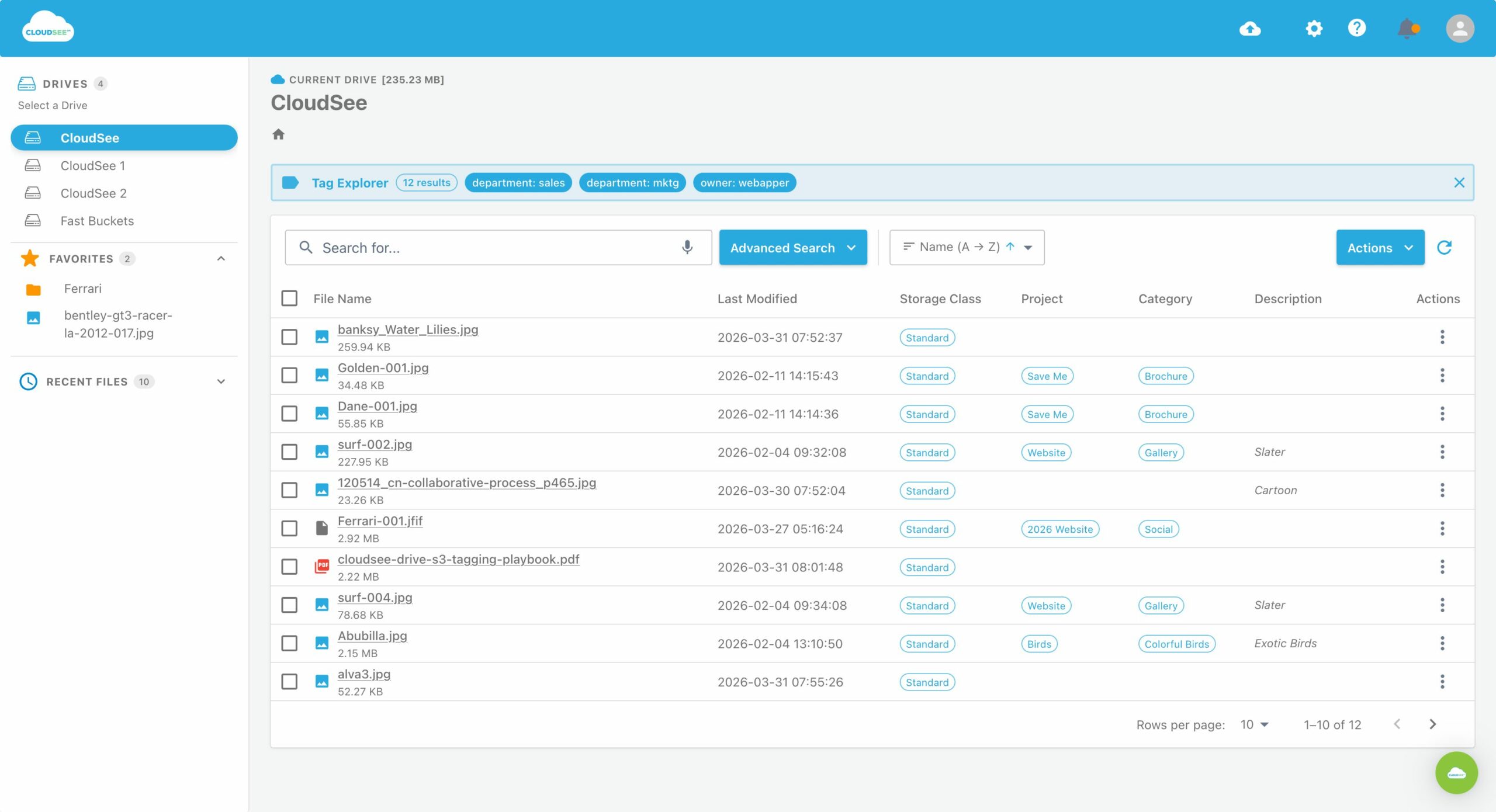
For teams on Amazon S3 who need search for their whole staff, CloudSee Drive’s Fast Buckets indexes your existing buckets in place so any file is searchable in under a second, and Tag Explorer finds files by object tag in about a second. Users only see the buckets their IAM permissions already allow, and nothing gets migrated.
S3-compatible object storage rewards boring discipline
Dropbox’s bet says the S3 API will outlast any single provider’s console, price sheet, or roadmap. Which backend your company runs on in five years may be a procurement call you don’t get a vote on. Your key scheme, your tag vocabulary, and your team’s ability to find a file are decisions you make this quarter. That work pays off on Amazon S3 today and carries over to whatever S3-compatible object storage shows up next.
If finding files in Amazon S3 is the weak link for your team, get a CloudSee Drive demo.
Leave A Comment