

Treat Your Buckets Like a Library, Not a Junk Drawer
Consider your S3 environment for a moment. How many buckets are you managing across all your accounts? A dozen? Fifty? Several hundred? Now imagine a new engineer joins your team and needs to find a specific log file from a customer incident eight months ago. How long would that take? For most AWS administrators and solutions architects, S3 starts as a simple object store and quietly becomes the default landing zone for logs, backups, ML training data, static assets, exports, and the occasional “we’ll clean this up later” experiment. Storage scales beautifully, but the findability does not. Somewhere along the way, the bucket list stops looking like a well-organized library and starts looking like a junk drawer with an AWS bill attached.
The Challenge of Searchable S3
S3 was designed as an API-first service, not a human-first one. It works extremely well when applications know exactly which key to fetch. It works significantly worse when people need to browse, explore, or search without a precise path. Three problems tend to compound over time…
- Organizational drift: Teams change, projects pivot, and naming conventions decay. The bucket called `prod-backups-final-v2` made sense to someone in 2021.
- Weak metadata discipline: Most objects land in S3 with little more than a key, size, and timestamp. There is no owner, no purpose, and no retention intent.
- Tooling gaps: The AWS Console is useful for inspection, but it is not a real discovery layer for large S3 estates.
The result is an environment where the data is technically available but practically lost. Engineers duplicate uploads, rebuild queries, or simply ask around until someone probably remembers.
Why It Matters
Reframing S3 as a library rather than a junk drawer creates three immediate benefits.
1. Incident response gets faster.
If your team can search S3 with confidence, it becomes much easier to locate logs, trace events, and support postmortems. That cuts down the time spent hunting for evidence when an incident is already stressful.
2. Storage costs drop.
A lot of enterprise cloud storage becomes dark data over time. You cannot archive, delete, or lifecycle what you cannot find. Searchability is the prerequisite for sane storage governance.
3 Compliance gets easier.
Data subject requests, audit prep, and retention enforcement all depend on being able to locate the right objects quickly. A searchable S3 estate turns those tasks from fire drills into routine operations.
How to Build a Searchable S3
You do not need to solve everything at once. Start with a few practical changes.
1. Establish a metadata contract.
Define a small required set of tags or object metadata keys, such as owner, environment, purpose, and retention. Keep it simple, enforce it in upload workflows, and treat untagged objects as exceptions rather than normal.
2. Standardize naming and structure.
Adopt a consistent naming convention for buckets and prefixes, such as `—`. Predictable names are part of the search strategy. When engineers can guess where something belongs, they can find it faster.
3. Use S3 Inventory and Storage Lens.
These two features are underused by many teams. S3 Inventory gives you a regular manifest of objects across buckets, while Storage Lens surfaces patterns, anomalies, and trends. Together, they help you create a catalog view of your environment.
4. Add a human-facing search layer.
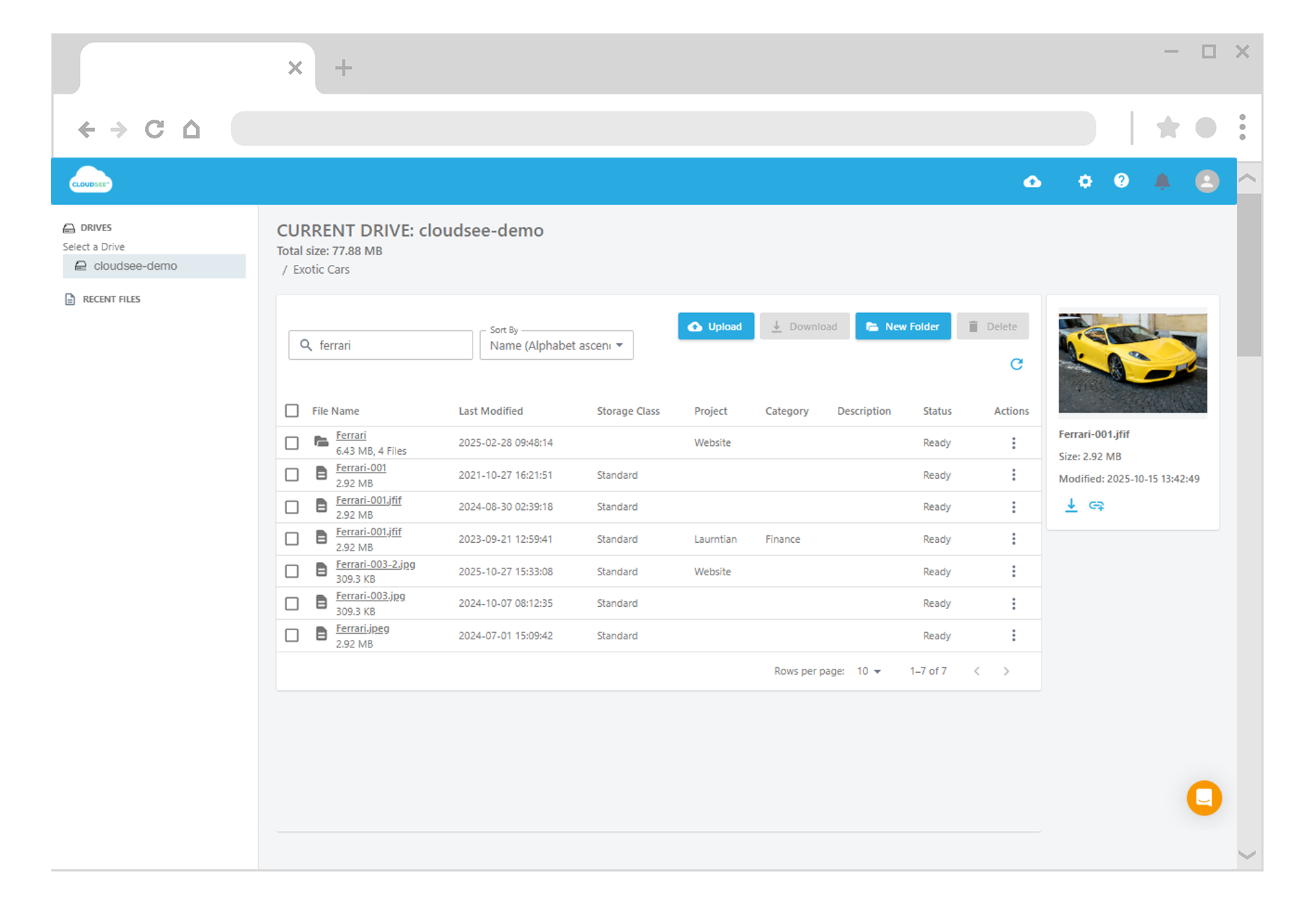
APIs and inventory files are necessary, but not sufficient. Your team needs a way to type a few words and find an object the way they would search a document repository. That is the missing layer in most S3 environments, and it is the gap CloudSee Drive is built to address.
A Simple First Step
Pick one shared bucket, ideally a high-traffic one, and run a 30-minute audit.
- How many objects can be identified by owner?
- How many have a clear purpose?
- How many have a retention policy attached?
- How much of the bucket would be hard to explain to a new engineer?
That exercise usually makes the case for metadata discipline faster than any policy memo.
Your “Searchable S3” Mindset
Your S3 buckets are not going away, and they are not getting smaller. The question is whether they evolve into a library, curated and searchable, or remain a junk drawer that quietly drains time, money, and confidence. The shift is less about new technology and more about mindset: objects should be easy to find, not just easy to store.
Ready to (Quickly) Make S3 Searchable?
CloudSee Drive turns sprawling S3 environments into searchable, browsable, human-friendly storage without changing where your data lives. Contact us for a quick walkthrough and see how fast “find that file” can actually be.
TL;DR
- S3 scales storage well, but human searchability is often neglected.
- Weak metadata, naming drift, and tooling gaps make objects hard to find.
- Searchable S3 improves incident response, compliance, and cost control.
- Start with metadata contracts, naming standards, S3 Inventory, and Storage Lens.
- Add a human-facing search layer to make S3 usable at scale.
Leave A Comment